We all have our own little guilty pleasures amongst our DVD collections, films that we watch when we’re glum or tired and very, very much on our own. You don’t want to watch these things with your buddies, see, because they’re massively embarrassing for one reason or other. They may have really crappy plots or autopilot scripting, or perhaps more emotional mush than the output of a flood at an instant mash potato factory. The acting may be so wooden that, with only a little sawing and polishing, you could easily fashion it into a neat bedside table and, in effects-laden films, we may find
The Muppets or
Button Moon more convincing depictions of reality than the cheese being touted onscreen. Sensible souls keep these discs in the same place as their prophylactics and haemorrhoid creams, the sort of nooks and crannies that friends and casual visitors won’t happen to chance across when visiting, and daren’t defend them when they’re rightly ridiculed in conversation. We keep our thoughts on them private, see, and daren’t tell anyone how we spend our guiltiest filmic moments. Well, mostly: my personal guilty pleasure is the 1992 Tim Burton movie
Batman Returns, a flick I fondly remember watching over-and-over as an kid for its dark, twisted visuals, fantastical plot and (for an eight year old) complex characters: how could the good guy fall in love with a baddie, after all? The shots of Michelle Pfeiffer wielding a whip in a PVC catsuit, sparking all sorts of previously unknown and confusing thoughts in my eight year old brain, had nothing to do with my repeat watching at all. And they certainly don’t factor into any decision I may make into watching it now.
Thing is, I know when putting the disc into my DVD player that I need to switch my brain off to enjoy it. I’m not watching it to be intellectually stimulated: it’s pure bumph and mental comfort food. Thinking about the silliness of it all too much will just ruin it, so best to sit back and let it wash over you like the celluloid bubblebath that it is. For other films or programmes, though, you don’t expect to do this, and particularly so for documentaries. Their whole purpose, after all, is to present factually informed opinions and data: they exist to educate and stimulate us with new information. What then, should we make of a documentary that has less in common with an educational experience and more of a guilty pleasure, the sort of thing that hardcore documentary-aficionados will scorn and only the bravest admit to truly liking? The kind of documentary that asks you to kindly switch your brain off before you’ll be able to enjoy it?
You can see where this is goingCall a spotlight, please, on the new Atlantic Productions/David Attenborough pterosaur documentary,
Flying Monsters 3D (cropped promotional poster and trailer shown above. All images used in this post are (c) Atlantic Productions). Hyped across the UK through a pretty extensive media campaign featuring articles in newspapers, TV guides, the Internet, television and even adverts on the London Underground, it’s a flagship show for Sky TV’s (the major subscription satellite TV company in the UK) new 3D channel, an attempt to show people that they should fork out for a 3D TV and Sky subscription even if they’re not interested in the major component of Sky 3D’s output, football. Much of the excitement about the programme has focused on its use of 3D technology, but there’s good reason to be excited about its content, too. The programme’s lead, Sir David Attenborough (shown below in a glider alongside the
FM3D Quetzalcoatlus), needs no introduction to anyone reading this and the producers, Atlantic Productions, are veteran CG palaeodocumentary makers that have cut their palaeodoc teeth on the pliosaur-based
Predator X, the
Darwinius feature
Uncovering Our Earliest Ancestor: The Link and Attenborough’s recent tour through the origins on life,
First Life. And it exclusively features pterosaurs for chrissakes, fantastic animals that have been begging for their own CG-laden documentary since
Walking with Dinosaurs demonstrated that photo-realistic CG creatures were not just the claim of Hollywood blockbusters. A handful of pterosaur researchers were consulted in the making of the film, too – David Unwin, David Martill, Michael Habib and myself were all involved to ensure the science was on the money. With credentials like that, it’s understandable that expectations were higher for this than for many palaeodocs and, indeed, the programme has caused a stir around the world with palaeobloggers-a-plenty eager for it to land on their cinematic shores this Spring. The
press reports have been positive too, with Attenborough and the technology of the film being highly praised in several articles.

Not having any of the necessary kit to see the show, I didn’t see the programme’s premiere at Christmas but, happily for me, my involvement as a technical consultant landed me and my other-half the chance to see a screening of the full length 70-minute version last Thursday (the upcoming cinema release is only 40 minutes). With such a stir around the film already, my hopes were high that everyone’s favourite leathery-winged beasties were about to get their moment in the media sun. Problem is, while some people are going to
love this film - they're going to lap up the effects, the bizarreness of pterosaurs and the whispered Attenboroughness of it all, they won't be the people who're most excited about seeing it. No, I reckon that anyone with a real interest in palaeontology or pterosaurs, the sort of people who tune into this little corner of Hardcore Pterosaur Blogging, for instance, will be pretty underwhelmed with the whole thing. Indeed, it's not going to blow away anyone who, you know, actually pays attention to the film. And here’s why.
 You look so fine
First up, credit given where it’s due: much has been made of the technology fuelling the 3D-enhanced presentation of
Flying Monsters 3D, and for good reason: the presentation is stunning (
FM3D Tupandactylus above). Most scrutiny will undoubtedly focus on the computer generated pterosaurs and – regardless of their scientific merit (we’ll get to that later) – they look dead impressive. Their fuzz and wing membranes ripple in the wind, their animation is smooth and their (entirely CG) environments look rich and convincing. As with most films of this kind, the lack of other animals in the CG scenes is notable, but given the time and expense it would take to render such effects, this is forgivable. The traditional photography is nicely done, too, with plenty of dramatic shots of fossil sites from helicopters, some fantastic close-ups of well-known pterosaur specimens and a suitably stirring, Thomas Newman-esque soundtrack overlying the whole thing to get the attention of your neck hair. The 3D, perhaps the most hyped component of the whole film, works well and, happily, isn’t gimmicky: there’s no cheesy 3D money shots to make audiences lurch about their seats and, instead, it only serves to add depth of vision to the pictures. Personally, I’m not sure the 3D really made the film a whole new visual experience: while impressive for the first five minutes, it quickly becomes par for the course, aside from the need to continuously push oversize 3D specs up your nose. Still, it all adds to the excellent presentation served up by Atlantic, and their cinematographers and computer wizards deserve several pats on the back for their work. Problem is, once you’ve taken in how nice everything looks, you start to focus on the story you’re being told and the content of the programme, and that's where the issues begin.
Psuedopterosaurology
As a documentary being presented by one of the most respected television natural historians of recent times, the content of
FM3D has to match up to it’s presentation for it to be considered a real success. Alas,
Flying Monsters 3D is a bit of a letdown here: I need to be careful with my own impressions here as, being a chap who’s been called a ‘pterosaur expert’ more than once, I may be more critical of the programme’s content than most. Thing is, this background means that I spent a lot of the film noting gross inaccuracies and misrepresentations of pterosaur knowledge, and this is surely a major failing of anything programme pretending to be a fact-based documentary. Take, for instance, the way that we’re explicitly told that pterosaurs were out-competed by birds and their ability to adapt to new ecologies, thus sealing the extinction of the more evolutionary-stagnant pterosaurs. Detailed analyses of bird and pterosaur diversity have either proved inconclusive on this issue (as in, we don't have enough data to say either way) or categorically stated that there's no evidence for bird-driven pterosaur extinction (Buffetaut et al. 1996; Slack et al. 2006; Butler et al. 2009; Dyke et al. 2009): claims like this really don’t reflect consensus opinions in the pterosaur scientific community. Elsewhere in the programme, we’re told that aktinofibrils – the stiffening fibres of pterosaur wings – enabled them to mould their wings in a very refined, precise way. These have been confused here with the muscle layer thought to be running through pterosaur wing membranes (Unwin 2005): aktinofibrils likely stiffened the wing or served as folding aids (Padian and Rayner 1983; Bennett 2000). Roborhamphus, the digital walking non-pterodactyloid pterosaur, is presented as strict fact despite
still not being peer reviewed (and contradicting other evidence – see Bennett 1996) and the large tapejarid
Tupandactylus is consistently called
Tapejara despite being separated from this genus four (yes,
four) sodding years ago (Kellner and Campos 2007). I mean, if you can't even be bothered to give them the right names...

Many sequences of the programme also shake the wrong end of the pterosaur stick, giving a rather inaccurate portrayal of pterosaur research and its history. A good chunk of the programme is given to the discovery of the
Dimorphodon holotype, a partial skeleton found in 1828 in Dorset, as if it were pivotal in revealing pterosaurs to the world and understanding pterosaur morphology. This just isn’t the case: the first pterosaur fossil known to science, the complete skeleton of
Pterodactylus antiquus, was found in 1784 and was a far more important specimen to our initial appreciation of pterosaurs. Not only did this fossil give pioneering scientists like Georges Cuvier the ability to interpret pterosaurs as extinct flying reptiles, but it was also a cornerstone for demonstrating concepts such as life before man, the use of comparative anatomy in identifying fossil animals and even extinction itself (Taquet and Padian 2004). While
Dimorphodon was an important contribution to our knowledge of pterosaurs in 1828, it really did little more than demonstrate the temporal, geographic and morphological range of pterosaurs: it had nothing to do with discovering what pterosaurs actually
were (and, besides, we didn’t see what
Dimorphodon really looked like until the latter half of the 1800s, almost 100 years since pterosaur research began [Owen 1870]). Indeed, the programme’s emphasis on
Dimorphodon as a completely known early pterosaur isn’t entirely clear: other forms (e.g.
Preondactylus,
Peteinosaurus and numerous campylognathoidid-like things) are as completely known and much older. (
FM3D Quetzalcoatlus shown above)
It gets worse. For some reason, considerable screen time is given to the idea that
Tupandactylus (sorry, ‘
Tapejara’) had an ultra-sensitive headcrest capable of ‘autopiloting’ it’s flight. What’s more, we’re told that with backswept-wings, the same ornament would enable
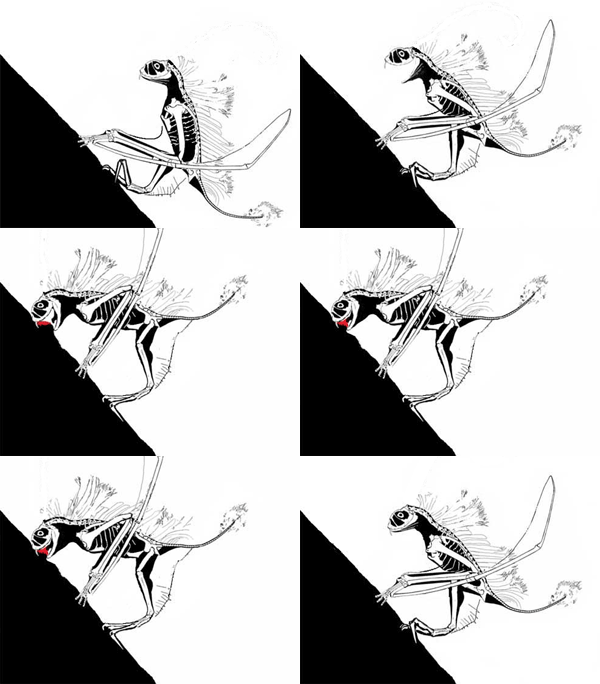
Tupandactylus to sail through water like a reptilian trimaran (as in, with it’s belly and legs acting as a hull and the wings and crest posing as sails). These ideas come courtesy of biomechanicist Sankar Chatterjee, who’s work builds upon minor statements about the sailing potential of other tapejarids made by Dino Frey and colleagues in 2003 (note that other discussions of sailing pterosaurs primarily focus on the antler-crested form
Nyctosaurus: we don’t have time to go into them here). The science behind these claims has yet to reach the peer-reviewed press, however, and the idea of pterosaurs sailing in this manner has not gained any acceptance in mainstream pterosaur circles: with all due respect to Professor Chatterjee, I’m surprised the programme makers gave so much screentime to an idea that has such a long way to go before being accepted by the pterosaur community when there are other, equally interesting and far less controversial ideas they could have explored. They could’ve, for instance, demonstrated far more concrete ideas about crest dimorphism: virtually every animal in the film has a headcrest, giving the impression to pterosaur-savy individuals that the pterosaur social scene was something of a sausage fest. One sequence in particular stands out as the pterosaur equivalent of
Brokeback Mountain.
 Subjackanory
These problems – and I’ve only listed a few - are bad enough, but the most surprising letdown of all is that the show lacks good narrative, a shock considering the involvement of the Godfather of natural history films. We’re taken through a simplistic version of pterosaur evolution, looking at
Dimorphodon,
Darwinopterus,
Pteranodon,
Tupandactylus (sorry, ‘
Tapejara’), and
Quetzalcoatlus, a sequence that takes us from the early Jurassic to the late Cretaceous. Along the way we’re introduced to some different species and concepts of pterosaur locomotion and anatomy and, in theory, this should work fine. In actuality, though, it’s rather clumsily handled. We’re told at the film’s midpoint that
Tupandactylus had fur (a claim based on fossils, apparently, but the only
Tupandactylus I know of with an alleged ‘beard’ has not been studied nor even mentioned in the technical literature. Having seen photos, I’m not sure that the alleged beard isn’t actually an errant plant fossil) and that this suggests it’s able to control it’s body temperature. It’s pretty accepted that most – if not all – pterosaurs were covered in fuzzy pycnofibres, and it’s not at all unreasonable to assume this may have been important to their ability to fly: why is this specifically mentioned for
Tupandactylus but no other pterosaurs, then? (Scavenging
FM3D Quetzalcoatlus shown above. Note that scavenging habits for these animals has never really gained much acceptance amongst pterosaurologists - see Witton and Naish [2008])
Often, the narrative feels entirely ad-libbed. The discussion of the concept that pterodactyloids represented a significant upgrade in terrestrial capability from their ancestors brings in the discussion of the split uropatagia in pterodactyloids when, prior to this point, viewers had not been introduced to the idea that there was any sort of hindlimb-anchored membrane at all (well, unless they’d been paying close attention to the CG sequences). Later, Douglas Lawson talks us through estimates of how large
Quetzalcoatlus northropi was thought to be in the 1970s (about 17 m across the wings – see Greenewalt 1975) but the producers keep any subsequent size estimates (more like 10 m - see Witton and Habib 2010) to themselves: the point is set up, but never finished. There’s a massive contradiction, too, the bristle-toothed ctenochasmatoid
Pterodaustro is identified halfway through the film as a filter feeder, only for Attenborough to close the film in front of a flamingo flock and inform us that pterosaurs never achieved the diversity modern birds have, including never evolving filter feeding forms. All told, it seems like this was a story told on the fly with little continuity checking between scenes. Indeed, we left the theatre wondering if anyone with access to the script, let alone someone with a background in pterosaur research, had read the narrative from beginning to end or really had a good, solid grasp of what they were trying to say.
 All down to the 1s and 0s
It’s left to the CG pterosaurs to justify your subscription to Sky 3D or IMAX theatre ticket, then, but they’re not quite strong enough to support the whole thing alone. They are lovingly rendered and, anatomically speaking, not
too bad (though there were a whole load of suggestions made that were rejected for aesthetic or economic reasons -
FM3D Dimorphodon, shown above, has suffered a lot in this regard), but their flight animations – the main way we see them - are too sinuous and, like most prehistoric beasties on film, they scream and wave their heads around far too much. Overall, the
Tupandactylus and
Darwinopterus probably come out best, though some scenes, such as the sailing tapejarids, hawking
Darwinopterus and crashing
Dimorphodon aren’t convincing at all. Two of these instances are actually laughably bad (apologies to the animators, but the
Dimorphodon sequence is begging for a WWII plane crashing sound effect to be added over the top: seriously, animals just don’t spiral out of the sky like that!). As such, I’m not sure they’ll come across as convincing to anyone who’s familiar with actual animal movement and behaviour, and folks who know pterosaur anatomy will wince at the flexibility of their backs and tails, the floppy-curtain effects of the wing membranes on the grounded animals and the stiff, perpetually-forward facing heads. They have got a lot right: their feet are plantigrade, they launch quadrupedally and their limbs held are positioned parasagittally, but their movements are too exaggerated. CG animators will do well to learn that animals don't move like they’re acting in silent movies. Plus, Attenborough actually interacts with the CG models in some scenes and, call me boring, but these come across as pretty trite and nuke
FM3D’s fridge: the models aren’t really convincing enough to stand up to their real-world surroundings, and they come worrying close to turning Attenborough from respected educator into a children’s performer (see image, below, of the
FM3D Quetzalcoatlus soaring alongside Attenborough's glider).
 So... you didn't like it then?
Not really. As a pterosaur documentary it's probably the best one yet - though that's hardly a mean feat - but it's a pretty sub-par programme in it's own right. Thing is, I wouldn’t normally care: most palaeodocs are, unfortunately, pretty terrible at the best of times, but this one could’ve been so much more. Why so many silly mistakes? Why such chaotic narrative? Pterosaurs are awesome animals: the fact that they formed the focus of such a prestigious documentary shows their public appeal and the numerous articles, webpages and books written about them denotes their hardcore interest. Alas, the media hype for the film betrays the real interest of the filmmakers: the technology behind the film. Indeed, search the websites associated with the flick and you’ll not find any mention of the science behind the piece: there’s some basic facts about pterosaurs, but the vast majority of the hype concerns the involvement of David Attenborough and the details of making a film in 3D. As mentioned above, this will be enough for some who're bowled over by the snazzy visuals and polish, but anyone who doesn’t knock their brains to ‘off’ when slipping the 3D glasses on will find it disappointingly empty. It really seems that, with a bit more care, this could’ve been as much of an achievement for effective scientific communication as it has been for 3D technology, but it’s really an enormous missed opportunity. The kind of thing, in fact, that makes a technical consultant want to grab a beer or two and reach for that guilty pleasure DVD. Despair, despair, despair.
References
- Bennett, S. C. 2000. Pterosaur flight: the role of actinofibrils in wing function. Historical Biology, 14, 255-284.
- Buffetaut, E., Clarke, J. B. and Le Lœuff, J. 1996. A terminal Cretaceous pterosaur from the Corbiéres (southern France) and the problem of pterosaur extinction. Bulletin de la Societe Geologique de France, 167, 753-759.
- Butler, R. J., Barrett, P. M., Nowbath, S. & Upchurch, P. 2009. Estimating the effects of the rock record on pterosaur diversity patterns: implications for hypotheses of bird/pterosaur competitive replacement. Paleobiology 35, 432-446.
- Dyke, G. J., McGowan, A. J., Nudds, R. L. and Smith, D. 2009. The shape of pterosaur evolution: evidence from the fossil record. Journal of Evolutionary Biology, 22, 890-898.
- Frey, E., Martill, D. M., and Buchy, C. C. 2003. A new species of tapejarid pterosaur with soft tissue head crest. In: Buffetaut, E. and Mazin, J. M. (eds.) Evolution and Palaeobiology of Pterosaurs, Geological Society Special Publication, 217, 65-72.
- Kellner, A. W. A. and Campos, D. A. 2007. Short note on the ingroup relationships of the Tapejaridae (Pterosauria, Pterodactyloidea). Boletim do Museu Nacional, Nova Séroe, Rio de Janeiro - Brasil. Geologia, 75, 1-14.
- Greenewalt, C. H. 1975. Could pterosaurs fly? Science, 188, 676.
- Owen, R. 1870. A monograph of the fossil Reptilia of the Liassic Formations Part Third. Plesiosaurus, Dimorphodon, and Ichthyosaurus. Palaeontographical Society Monograph, 41–81.
- Padian, K. and Rayner, J. M. V. 1993. The wings of pterosaurs. American Journal of Science, 293, 91-166.
- Slack, K. E., Jones, C. M., Ando, T., Harrison, G. L. (A)., Fordyce, R. E., Arnason, U. and Penny, D. Early penguin fossils, plus mitochondrial genomes, calibrate avian evolution. Molecular Biology and Evolution, 23, 1144-1155.
- Taquet, P. and Padian, K. 2004. The earliest known restoration of a pterosaur and the philosophical origins of Cuvier’s Ossemens Fossiles. Comptes Rendus.Palaevol, 3, 157-175.
- Unwin, D. M. 2005. The Pterosaurs from Deep Time. Pi Press, New York, 347 pp.
- Witton, M. P. and Habib, M. B. 2010. On the size and flight diversity of giant pterosaurs, the use of birds as pterosaur analogues and comments on pterosaur flightlessness. PLoS ONE, 5, e13982.
- Witton, M. P. and Naish, D. 2008. A reappraisal of azhdarchid pterosaur functional morphology and paleoecology. PLoS ONE, 3, e2271.