Sunday, November 11, 2012

How giant pterosaurs are struggling to take off from the sinking ship of science journalism


This week, it emerged that the giant azhdarchid Quetzalcoatlus was an atrophied, under muscled animal that was weak and inefficient at takeoff, and could only launch through use of running bipedally with flapping wings, headwinds and downward sloping ground. The newly proposed idea of quadrupedal launch, where pterosaurs became airborne via powerful leaping with all four limbs (Habib 2008) is hokum, being the stuff of fantasy and overly zealous application of bat launch strategies to flying reptiles. 70 kg is the maximum mass that these giants and all other flying animals could achieve, and recent discussions that they were considerably more massive (Paul 2002; Witton 2008; Henderson 2010; Witton and Habib 2010) are plain wrong.


At least, that’s what a recent press release by Sankar Chatterjee and colleagues would have us believe. (Above image: the pterosaur launch battleground. At top is a quad launching Hatzegopteryx, a giant azhdarchid; below, is a bipedally launching Quetzalcoatlus using taxiing, headwinds and a slope to become airborne. Hatzegopteryx is from Witton [2013]; Quetzalcoatlus is from Chatterjee and Templin [2004]) Speaking at the Geological Society of America 2012 conference recently held in Charlotte, N.C., Chatterjee (of the Museum of Texas Tech University; most notable within recent pterosaur research for his contribution of windsurfing tapejarids to the Attenborough pterosaur documentary) and colleagues outlined why he considers much of the recent discussions of giant pterosaur flight dynamics to be flawed in a short presentation, and decided to disseminate their ideas further through the public press. Although the press reports for this story have been relatively widespread, the response from pterosaur researchers to this release has been generally negative, largely because the claims do little to address the recent developments and hypothesis shifts within pterosaur flight studies and largely parrot the findings of Chatterjee and Templin’s 2004 paper on pterosaur flight. Pterosaur.Net’s own Mike Habib, one the key modern researchers on pterosaur flight, offered this take on the release:

Unfortunately, this looks like the argument comes down to ‘but we got a different answer in 2004!’ Yes.  We know, and for five years I've explained why it is probably wrong.  Oh well.”

Chatterjee et al.’s abstract and press release do not explain why the many arguments supporting pterosaur quad launch (see here and here, for a start) are problematic or why arguments and methodologies to estimate relatively high masses for pterosaurs (here) are incorrect. Instead, they’ve decided that such scientific rigour doesn’t matter, and gone straight into informing the public that giant pterosaurs took flight in the way described in their presentation, and that all other opinions on the matter are wrong.

By bigging up their abstract rather than a peer-reviewed publication in which their methodological details and discussion are explained in detail, Chatterjee et al. have given the impression that their work is more scientifically credible than it actually is. Science journalists have lapped the release up, presumably because giant pterosaurs are cool, but they have not mentioned the lack of a detailed peer-reviewed study behind the findings, nor (in the majority of cases) bothered to find out what other palaeontologists make of the story. This is not the first time this sort of outreach has happened. The proceedings of other conferences and un-reviewed articles have given us infamous press stories such as the ‘Triassic kraken’, vampire pterosaurs, and the suggestion that all dinosaurs were aquatic. And these are just examples from recent memory.

As a scientist concerned about effective and accurate scientific outreach, I find this sort of journalism very worrying. I have no problem with off-kilter ideas like those proposed by Chatterjee et al., but their desire for press attention without applying appropriate scientific rigour is extremely concerning. They have not documented their studies in a scientific paper, sought the opinions of other experts in peer review to construct a scientifically sound hypothesis and news piece. Instead, they went straight from the ‘idea’ phase of their project to media broadcasting, which, as I see it, has three effects. Firstly, it risks misleading the public if their ideas fail to meet scientific scrutiny (most of the ideas mentioned thus far in this article are guilty of this, and I strongly suspect the same is true of the Chatterjee et al. story). Secondly, it undermines the integrity of the scientists behind the story. The idea that “any publicity is good publicity” does not apply to scientists. Within academic circles, you become “the guy who went public with [crazy idea]”, which doesn’t do your reputation, or that of your institution, any favours. Thirdly and perhaps most importantly, such practises undermine science generally. It’s no wonder that palaeontology is often viewed as a speculative and unsubstantiated discipline when a lot of our press work concerns unsubstantiated, often ‘fringe’ or highly controversial ideas being presented as credible hypotheses. This only creates confusion among people as to what the leading hypotheses on given topics are or, when press stories have gaping holes in logic (e.g. the Triassic kraken, aquatic dinosaurs) show scientists as bumbling, foolish individuals incapable of using common sense.

This is a serious problem which we, as scientists and scientific communicators, need to address. Many people are generally sceptical of scientists and their conclusions, concocting up ideas of scientists in scaremongering conspiracies for grant money, or seeking media attention to justify their employment at publically funded museums and universities. The manner in which scientists frequently present unsubstantiated work to non-academics does little to help restore our reputation with these individuals. While it’s of fairly trivial concern whether the public, or anyone for that matter, knows the ins-and-outs of pterosaur launch, all scientists need to think about the broad perception of science by the public. Scientists researching our many severe, modern crises need to be taken seriously, and press reports that expose incomplete or shoddy scientific work negatively impact this perception. Fairly or not, many people, tar all scientists with the same brush (for proof, check out the comments section on any science story publicised by the Daily Mail). We should be working to enhance the reputation of science among the public so that scientific opinions on critical issues like our on-going losses of biodiversity, climate change, sustainability of our lifestyles, energy conservation, and other real, genuine problems are trusted and taken seriously. Scientists leaping for the press with hypotheses that have yet to be suitably tested only present scientists as attention seekers, incompetent or both, and we cannot afford to perpetuate this idea further.

Of course, the fault does not only lay with the scientists. Science journalists also need to raise their game, becoming more circumspect when following and writing up of press stories, noting the state of the research involved, gauging its context within its field and, perhaps in some cases, ignoring clearly bogus, fringe reports entirely. I have worked with a great number of people involved in the scientific media who clearly do not have any interest in science beyond their job, and these are the worst people to be trying to turn the sometimes complex hypotheses of scientists into digestible material for laymen. As Brian Switek shows on a daily basis at Dinosaur Tracking, you become an exemplar science journalist not by just being a deft writer, but you have to give a crap about science too. Failure to fact check and presenting ideas inaccurately is miscommunication, which is clearly an enormous failing for an individual employed to dissemination of information.

In short, we need to stop thinking about scientific outreach as purely an exercise in getting the most attention possible to our research or science news articles. These short-term goals are damaging to science as a whole, which is what science communicators are meant to promote. Science communication is an opportunity to educate non-academics with new and exciting results of good scientific practise that have helped develop our understanding of the world and our place within it. We should take the responsibility that this task requires fully and seriously if we want our scientific voice to be listened to.

References
  • Chatterjee, S. and Templin, R. J. 2004.  Posture, Locomotion and Palaeoecology of Pterosaurs. Geological Society of America Special Publication, 376, 1-64.
  • Habib, M.B. 2008. Comparative evidence for quadrupedal launch in pterosaurs. Zitteliana, B28, 161-168.
  • Henderson, D. M. 2010. Pterosaur body mass estimates from three-dimensional mathematical slicing. Journal of Vertebrate Paleontology, 30, 768-785.
  • Paul, G. S. 2002. Dinosaurs of the Air: The Evolution and Loss of Flight in Dinosaurs and Birds. John Hopkins University Press, Baltimore, 472 pp.
  • Witton, M. P. 2008. A new approach to determining pterosaur body mass and its implications for pterosaur flight. Zitteliana, B28, 143-159.
  • Witton, M. P. 2013. Pterosaurs: Natural History, Evolution, Anatomy. Princeton University Press. [In press]
  • Witton, M. P. and Habib, M. B. 2010. On the size and flight diversity of giant pterosaurs, the use of birds as pterosaur analogues and comments on pterosaur flightlessness. PLoS ONE, 5, e13982.


Sunday, July 15, 2012

Some pterosaur related goodness

As people might know, I've recently started blogging for the website of The Guardian newspaper in the U.K. Coupled with the Musings, Pterosaur.net and my occasional contributions to other sites like the 21st Floor means that I can be spread a bit too thin these days. As such I'm rather behind on here, despite rather obviously having some top pterosaur-related goodness that I should be talking about.


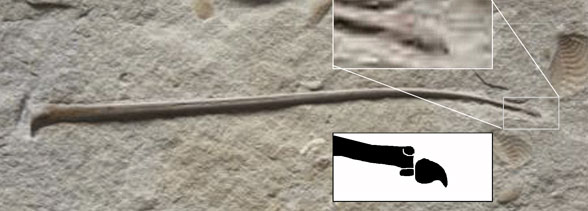
Most obviously, just a week ago, my first paper come out in which I named a pterosaur. Named Bellubrunnus, this is an absolutely stunning specimen - I mean, just look at it. Inevitably there's a series of posts by me on it and it's implications for pterosaur evolution (here, here, here and finally here). Best of all, the paper is in PLoS ONE and so freely available to all who want to read it.

More recently, Pterosaur.net contributor Luis Rey has set up a blog for his new artwork. One of the first things he's done is a brand new image of Darwinopterus coming in to land on a tree trunk based on a conversation we'd had and a sketch I knocked up for him. Two versions are actually out there and you can catch up with them here and here.

Friday, July 6, 2012

Cross/Guest Post: Thin vs Thick Wings

I have a special treat this evening.  Colin Palmer has been kind enough to write a guest post on the relative performance advantages and dynamics of thin and thick wings, especially in the context of animal flyers.  Colin is located at Bristol University.  He is an accomplished engineer with an exceptional background in thin-sectioned lifting surfaces (particularly sails).  Colin has turned his eye to pterosaurs in recent years, and he has quickly become among the world's best pterosaur flight dynamics workers.  You can catch his excellent paper on the aerodynamics of pterosaur wings here.  Press release on it can be found here.


This is a cross post from Aero Evo.  If you want to comment on the post, I recommend going there, as that means Colin only has to watch one site at a time (remember, he supplied this at of the goodness of his heart!)

--MH

------------------------
Thin And Thick Wings
Colin Palmer

In the early days of manned flight the designers took their inspiration from birds. One of the consequences was that they used thin, almost curved plate aerofoil sections. This seemed intuitively right and certainly resulted in aeroplanes that flew successfully. However towards the end of the First World War the latest German Fokker fighters suddenly started to outperform the Allied planes. Counterintuitively their wing sections were thicker-surely these sections would not cut the air so well so how could they possibly have enabled aeroplanes to fly faster and climb more quickly. But that was what was happening, the Germans had done their research and discovered that a combination of a cambered aerofoil with the correct thickness distribution gave superior aerodynamic performance. Subsequently all aircraft had similar teardrop shaped wing sections and soon there was a massive body of experimental and theoretical work available that enabled designers to select just the aerofoil they required.

Fast forward to the period after the Second World War and an explosion of interest in applying the latest aerospace science to the traditional arts of sailing. Many people looked to aircraft and logically assumed that sailboats would perform better if only they could be fitted with wing sails, like up-ended aircraft wings. Surely this had to be more efficient than the old-fashioned sails made of fabric and wire, just like the earliest aircraft. But the results were disappointing. Not only on a practical level where the wing sails proved unwieldy and unsuited to operating in a range of wind conditions, but perhaps more worrying they offered no obvious performance advantage and indeed in light winds they were significantly inferior, area for area. What was going on? Why didn't the massive investment in the development of aircraft wing sections have anything to offer to sailboats?

The answer lay in understanding the effect of Reynolds number. From the very earliest days of manned flight aircraft were operating at Reynolds number approaching 1 million and as speeds increased so did the Reynolds numbers, so it became customary for aerofoils to be developed for operation at Reynolds numbers of 2 to 3 million or more. But sailboats are much slower than even the slowest aircraft so the operational Reynolds numbers are lower than for aircraft, typically in the range from 200,000 to 500,000, right in the so-called transition region. It turns out that in this Reynolds number range the experience and intuition gained from studies at significantly higher values can be very misleading indeed. In the transition region a curved plate, (membrane) aerofoil can be more aerodynamically efficient than a conventional thick aerofoil.

This transition Reynolds number range is also where most birds and bats operate, and from what we know of pterosaurs it was also their domain. Consequently natural forms are not necessarily disadvantaged by having the membrane wings of bats or pterosaurs or the thin foils of the primary feathers in the distal regions of bird wings.

But there is a complication. A curved plate or, to an even greater extent, a membrane aerofoil has very little intrinsic strength and requires some form of structure to keep it in place and keep it in shape. On sailing yachts this structure is a thin tension wire that supports the headsail or the tubular mast in front of the mainsail. In order to tension the wire for the headsail, very large forces are required which places the mast in considerable compression, normally requiring a guyed structure that can have no direct analogue in nature. Natural forms are restricted to using a supporting structure which is loaded in bending and restrained by attached muscles and tendons. Generally speaking, the bending resistance of a structure depends upon the depth of the cross-section, so as bending load increases the diameters of the bones must increase otherwise the wing will become too flexible.

This is where the apparent superiority of the membrane wing may be compromised, because the presence of structural member severely degrades the aerodynamic performance. The structural member may be along the leading edge of the aerofoil as in the case of bats and pterosaurs, or close to the aerodynamic centre as in the case of the rachis of the primary feathers of birds. In all cases the loss of performance is less if the supporting structure is on the pressure side (the ventral side) of the aerofoil. It is therefore most likely no coincidence that this is the arrangement of the wing bones and membrane in bats and the rachis and vane in primary feathers. It was therefore also most likely that the wing membranes of pterosaurs were similarly attached to the upper side of the wing finger. Even in this configuration there is a substantial penalty in terms of drag, although it may result in some increase in the maximum lift capability of the section, due presumably to an effective increase in camber. (Palmer 2010).

This aerodynamic penalty arising from the presence of the supporting structure may perhaps be the reason why birds’ wings have thickness in the proximal regions, where the performance of such a thick aerofoil is superior to a thin membrane obstructed by the presence of the wing bones. More distally, where the wing bones become thinner or are not present, the wing section reverts to a thin cambered plate formed by the primary feathers. On the bird’s wing the proximal fairing of the bones into an aerofoil section is achieved by the contour feathers with very little weight penalty. This is not possible in bats (and presumably also in pterosaurs) where any fairing material would, at the very least, need to be pneumatised soft tissue, resulting in a considerable weight penalty as compared to feathers. In the absence of aerodynamic fairing around the supporting structure, aerodynamic efficiency can only be improved by reducing the cross-section depth of the bones - the general shape of the section having very little effect. But reducing the section depth results in a large increase in flexibility since the bending stiffness varies as the 4th power of section depth, so there are very marked limits to the effectiveness of this trade-off.

It may therefore be no coincidence that where the cross section depth has to be greatest, in the proximal regions of the wing, both bats and pterosaurs have a propatagium, which means that the leading-edge of the wing section is more akin to the headsail of a yacht, stretched on a wire, than a membrane with the structural member along the leading-edge. Wind tunnel tests have shown that moving the structural member back from the leading-edge, while keeping it on the underside of the wing section, results in a significant increase in aerodynamic performance.

Thursday, July 5, 2012

Meet Bellubrunnus: New Pterosaur in PLoS ONE

Dave Hone and colleagues have just published a fantastic description of a new pterosaur in PLoS ONE.  You can read (and download, if desired) the paper here.  This new critter is particularly fun because it has wingtips that curve anteriorly; which is unique among pterosaurs known to date.  Very cool stuff, and if you want to know more, obviously read the full paper, as well as the discussion by Dr. Hone himself at Archosaur Musings.

Here is a section of the Abstract from the original article:

Methodology/Principal Findings
The specimen was examined firsthand by all authors. Additional investigation and photography under UV light to reveal details of the bones not easily seen under normal lighting regimes was completed.
Conclusions/Significance

This taxon heralds from a newly explored locality that is older than the classic Solnhofen beds. While similar to Rhamphorhynchus, the new taxon differs in the number of teeth, shape of the humerus and femur, and limb proportions. Unlike other derived non-pterodacytyloids, Bellubrunnus lacks elongate chevrons and zygapophyses in the tail, and unlike all other known pterosaurs, the wingtips are curved anteriorly, potentially giving it a unique flight profile.

Cheers!

--MH


Wednesday, July 4, 2012

Pterosaur.Net wades in against ReptileEvolution.com

This has to be quick, as I'm close to emerging from  seemingly never-ending book revision and want to finish it as soon as possible, but something of interest to Pterosaur.Net readers (and, indeed, anyone with an interest in palaeontology, natural history or science communication) has emerged that needs bringing to the widest possible attention. Over at Tetrapod Zoology, Darren Naish has recently published a long, detailed critique of the many problems inherent with a website with worrying Internet presence, David Peters' ReptileEvolution.com. The title of the piece, "Why the world has to ignore ReptileEvolution.com" probably tells you everything you need to know about its content but, if that doesn't spell it clearly enough, its loud message at the top of the page makes the point clearer:

ReptileEvolution.com does not represent a trustworthy source that people should consult or rely on. Students, amateur researchers and the lay public should be strongly advised to avoid or ignore it."

But why should you care? 
In all likelihood, if you're reading this post, you are already familiar with Peters, his website and its sister blog, The Pterosaur Heresies. Even if these names are not familiar however, there is a good chance you have bumped into them when Googling almost any Mesozoic reptile you care to think of. Peters is well-known in palaeontological circles (though perhaps mostly ignored by the professional palaeontological community now) for his unorthodox views on amniote phylogeny and, perhaps more commonly, his sometimes bizarre interpretations of pterosaur anatomy and functional morphology. For years, Peters has been using a technique known as "Digital Graphic Segregation", tracing photographs of fossils and interprets actual bone, marks in the surrounding matrix, and probably preparation, printing and jpeg compression artifacts, to reconstruct the anatomy of fossil animals. Observations on actual specimens are very much of secondary concern and do not factor into this technique much, if at all. This leads to the frequent identification of  features that simply do not exist on the actual specimens (see Peters' reconstruction, above, of Anuroganthus ammoni for an example [source]. Note the number of phalanges in the wing finger, shape of the skull and long, fibrous tail. Go here to compare this with the best-preserved specimen of this pterosaur) and, when fed into a phylogenetic analysis, the resultant trees are understandably completely incongruous with anything seen in 'mainstream' literature. Peters' work has been rightly criticised from all angles (including Bennett 2005; Hone et al. 2009, this, and frequently on the Dinosaur Mailing List) but he retains his ideas in the face of overwhelming evidence to the contrary (i.e. the inability to see the structures he claims to find on actual specimens despite microscopic, and UV observation, and CT scanning). As such, the work portrayed on his website and blog has to be pseudoscience, at best.

Above, ReptileEvolution.com image allegedly demonstrating the  presence of a fifth wing phalanx in the pterosaur wing. Consistent observations of pterosaur fossils, by contrast, suggest they only had four phalanges, or sometimes three.  From here.

This, in itself, is not really the problem. As Darren points out, the Internet is a place for creative, free thinking individuals and, hey, if you cannot express your opinions here, where can you? The issue taken with ReptileEvolution.com is not that it exists, but that it's internet presence has grown to the point that it is now a top-listed site for many palaeo-based searches. Tap virtually any Mesozoic reptile species into Google and either ReptileEvolution.com or the Pterosaur Heresies is likely to be in the first few hits. The situation is even worse for image searches, which are increasingly dominated by the many graphics that Peters' uses on his sites. This would seemingly be because Peters is extremely prolific in his output on these projects, and because most Mesozoic reptiles are poorly covered online.

Those In The Know are, at worst, merely frustrated by this situation, as it skews search results from other hits that may be of interest. Those who are not familiar with Peters' work or sites however, are potentially being mislead by his very professional-looking websites that frequently present their content as hard biological facts rather than the eccentric views of one individual. I have heard anecdotes of news outlets citing ReptileEvolution.com and, not many months ago, we ran into a direct example of one website blindly following Peters' ideas (we weren't impressed). This is a worrying trend.

We have more-or-less ignored Peters' work at Pterosaur.Net, which may seem surprising given that he has dedicated a whole blog, more or less, to deconstructing the 'mainstream' view of pterosaur palaeobiology. ReptileEvolution.com even has a page dedicated to picking holes in the main Pterosaur.Net site! I suppose we have more interest in discussing other topics on our blog than merely rehashing the same anti-Peters arguments over and over. Most of us have had discussions with Peters about his ideas and hypotheses at one venue or another anyway, so I guess we've 'moved on' in some respects. Regardless, I'm sure I speak for my colleagues here at Pterosaur.Net when I say that we are as concerned over the prevalence of ReptileEvolution.com and the Pterosaur Heresies as Darren is at TetZoo, and want to bring these concerns to the widest possible audience. Hence, I urge you to read Darren's discourse if you have not already done so and, if you are concerned about the accurate portrayal of palaeontological science online, then blog, tweet and discuss this issue as much as you see fit. As may be expected, Peters has started a rebuttal of the piece across a number of blogposts, which begins here.

That will have to do: I've gone on far longer than planned. Back to the book...

References
  • Bennett, S. C. 2005. Pterosaur science or pterosaur fantasy? Prehistoric Times, 70, 21-23.
  • Hone, D. W. E., Sullivan, C. and Bennett S. C. 2009. Interpreting the autopodia of tetrapods: interphalangeal lines hinge on too many assumptions. Historical Biology, 21, 67-77.

Monday, July 2, 2012

They keep on coming

Yes descriptions of new pterosaurs don't quite keep up with the rates of new dinosaurs, but they don't do badly either. This is the skull of Morganopterus, yet another (and yes, arguably one of too many) boreopterids to come out of China in recent years. While the group is already known for having long, low heads with far too many teeth, this one does seem to be going for a record.


It's big too - nearly a metre long if you include the little crest off the back of the head (and there's a small one over the tips of the upper jaw too). Not too many years ago Pteranodon was the only pterosaur known with this kind of posteriorly directed head-crest but now we have Ludodacylus and Morganopterus too so they're starting to be come pretty common in the ornithocheiroids. I'd be far from surprised if a few more didn't turn up in the next few years on new species or better specimens of already recognised taxa.

This is a nice specimen and it seemed too interesting not to share, though I don't have too much to say about it right this minute. Still, if new pterosaurs are your thing, stay tuned, there's something due out Thursday which I hope will turn a few heads.

P.S. The image is Fig 1 in the paper, but this version was kindly sent to me by Lu Junchang.

Wednesday, June 13, 2012

Cross-Post: Feathers vs Membranes

A recent discussion arose on the Dinosaur Mailing List that included some questions regarding the relative merits of membrane wings and feathered wings, mostly in the context of pterosaurs vs birds. In that spirit, I thought I'd give a little rundown of the relative advantages/costs of each type of vertebrate wing.  This was also posted on Aero Evo.

Avian Wings
Birds are the only flying vertebrates to use keratinized, dermal projections (i.e. feathers) to form their wings.  Feathers have the distinct advantage of being potentially separate vortex-generating surfaces, meaning that a bird can split its wing up into separate airfoils, thereby greatly changing its lift and drag profile as required (Videler, 2005).  Tip slots are the most obvious example of this mechanism, whereby the tip of the wing is split into several separate wingtips by spreading the primary feathers of the distal wing.  The alula, which lies along the leading edge of a bird’s wing, and is controlled by digit I, is another example of a semi-independent foil unit (Pennycuick, 1989; Videler, 2005).  The splayed primaries of a slotted avian wingtip passively twist nose-down at high angles of attack (and therefore at high lift coefficients), and this feather twist reduces the local angle of attack at the distal end of slotted avian wings, preventing them from stalling (Pennycuick, 2008).  Slotted avian wingtips may therefore be nearly "unstallable", though this does not prevent the overall wing from stalling (Pennycuick, pers comm.).  Feathered wings can also be reduced in span without an accompanying problem of slack and flutter – the feathers that form the contour of the wing simply slide over one another to accommodate the change in surface area.  Despite these advantages, feathers have some costs as wing components, as compared to membranous wings.  Feathered wings are relatively heavy (Prange et al., 1979) and cannot be tensed and stretched like a membrane wing (which has ramifications for cambering). Theoretically, avian wings should not be able to produce maximum lift coefficients as high as an optimized membrane wing (Cunningham, pers comm.), but experimental data to determine if transient, maximum lift coefficients actually differ significantly between bats and birds are not yet available (Hedenstrom et al., 2009).

Chiropteran Wings
Bats have a wing surface formed primarily by a membrane stretched across the hand, antebrachium, brachium, and body down to the ankle.  Unlike birds, which have a limited number of muscles that produce the flapping stroke (two, primarily: m. pectoralis minor and m. pectoralis major), bats have as many as 17 muscles involved in the flight stroke (Hermanson and Altenbach, 1983; Neuweiler, 2000; Hedenstrom et al., 2009).  The membranous wings of bats are expected to have a steeper lift slope than the stiffer, less compliant wings of birds (Song et al., 2008).  This results from the passive cambering under aerodynamic load that occurs in a compliant wing: as lift force increases, the wing passively stretches and bows upwards, producing more camber, and thereby further increasing the lift coefficient and total lift.  While there are some advantages for a flying animal in having such a passive system, bats presumably must mediate this effect with the many small muscles (and fingers) in their wings – tensing the wings actively while under fluid load will mediate the amount of camber that develops.  This would be important to mediate drag and stall, though no empirical data currently exist to indicate exactly how bats respond to passive cambering.  The work by Song et al. (2008) also indicates that compliant, membrane wings achieve greater maximum lift coefficients than rigid wings, but data have yet to be collected demonstrating that this holds in vivo for bats and birds.  Compared to birds, the distal wing spar in bats is quite compliant (Swartz and Middleton, 2008).

Pterosaur Wings
The structure and efficiency of pterosaur wings is obviously not known in as much detail as those of birds or bats, for the simple reason that no living representatives of pterosaurs are available for study.  However, soft tissue preservation in pterosaurs does give some critical information about their wing morphology, and the overall shape and structure of the wing can be used (along with first principles from aerodynamics) to estimate efficiency and performance.

It is known from specimens preserving soft tissue impressions that pterosaur wings were soft tissue structures, apparently composed of skin, muscle, and stiffening fibers called actinofibrils, though the exact nature and structure of actinofibrils has been the topic of much debate (Wellnhofer 1987; Pennycuick 1988; Padian and Rayner 1993; Bennett 2000; Peters 2002; Tischlinger and Frey 2002).  Associated vasculature is also visible in some specimens, especially with UV illumination (Tischlinger and Frey, 2002).  Recent work on the holotype of Jeholopterus ningchengensis (IVPPV12705) seems to confirm that the actinofibrils were stiffening fibers, imbedded within the wing, with multiple layers (Kellner et al., 2009).  The actinofibrils were longer and more organized in the distal part of pterosaur wings than in the proximal portion of the wing, which may have implications for the compliance of the wing going from distal to more proximal sections.  The inboard portion of the wing (proximal to the elbow) is called the mesopatatgium, and was typified by a small number of actinofibrils with lower organization, which would have made this part of the wing more compliant than the outboard wing.

The outer portion of the wing, which was likely less compliant the mesopatagium, is termed the actinopatagium (Kellner et al., 2009).   Because pterosaurs had membrane wings, they could presumably generate high lift coefficients, but exactly how high depends on certain assumptions regarding their material properties and morphology (pteroid mobility and membrane shape being two of these factors).

Now, for some punchlines...
Based on the structural information above, we might expect the following regarding pterosaurs and birds:

- Pterosaurs would have a base advantage in terms of maneuverability and slow flight competency.

- Pterosaurs would also have had an advantage in terms of soaring capability and efficiency

- Pterosaurs would have been better suited to the evolution of large sizes (though this was affected more by differences in takeoff - see earlier posts about pterosaur launch).

- Birds will perform a bit better as mid-sized, broad-winged morphs (because they can use slotted wing tips and span reduction).

- Birds would have an advantage in steep climb-out after takeoff at small body sizes (because they can work with shorter wings and engage them earlier).  This might pre-dispose them to burst launch morphologies/ecologies.

Interestingly enough, the fossil record as we currently know it seems to back up all of these expectations.  For example, the only vertebrates that seem to have been adapted to dedicated sustained aerial hawking in the Mesozoic were the anurognathid pterosaurs.  Large soaring morphs in the Mesozoic were dominated by pterosaurs, also.  On the other hand, mid-sized arboreal forms in the Cretaceous were largely avian.