Wednesday, March 28, 2012

The pterodactyl that fell down the back of the sofa, part 1: another ‘unexpected discovery’

It’s no secret that many palaeontological ‘discoveries’ aren’t made in the field, but are actually stumbled into by researchers working in museum collections. This is not surprising in the slightest: the flagship museums of many nations are rammed with - literally - millions of specimens. Some of these are virtually undocumented and unknown, even to experts in relevant fields, and require visiting researchers to be in the right frame of mind, to recognise and appreciate as something worthy of putting on record. It’s also well known that the preparation of many discoveries can take such a long time that the treasures brought back from exhibitions to exciting localities can sit, unknown, decades after decade. It is not inconceivable to imagine a whole career being forged by picking your way through the archives of big museums, looking at fossils that have been missed, unopened or in need of reappraisal.

Last week, I played this very game myself, by bringing attention to an overlooked pterosaur specimen held in the bowels of the Natural History Museum, London (Witton 2012 – free to download from PLoS ONE. Image, above, shows the title slide from a talk I've given on this research). The twist to my own version of this tale is that the element I described does not only belong to a very familiar pterosaur species, but a very familiar specimen. The short version of this story is that reappraising a long-forgotten component of a well-known British pterosaur suggests that its 100-year standard skull reconstruction is incorrect, which has obvious knock-on effects for its taxonomy and functional morphology. Those of you with lives to lead may as well log of here, but, if you have a lot of time to kill, read on over this series of posts for more back story and details.

The who

The animal in question is Istiodactylus latidens, a 4.2 m span ornithocheiroid from the Lower Cretaceous Vectis Formation, of the Isle of Wight (image, above, shows I. latidens launching, from my upcoming book. Some people may be happy to hear that the first draft has been submitted!). I. latidens is the largest species of Istiodactylidae and the only member of this group known to occur outside of Cretaceous deposits of China’s Liaoning region*. Istiodactylids are characterised by their muzzles of interlocking, razor-edged teeth and have been called the ‘duck-billed pterosaurs’ by some but, as we’ll see later, this analogy is plain daft: there is nothing at all duck-like about istiodactylid jaws). Istiodactylus has been known for a long time, though much of its early research history is murky. The documentation of its discovery, and early inventories of material referred to this species, are particularly vague. It’s not even known how pterosaur grandpapa Harry Seeley knew of I. latidens unusual teeth when he named the species in 1901, as the holotype specimen appears to lack jaw elements (‘latidens’ means ‘broad tooth’). Howse et al. (2001) suggested that an un-described skull in the University Museum of Zoology, Cambridge may belong to the holotype material, but this has not been confirmed. Seeley’s naming of the material was also of borderline validity, and some nomenclatural wrangling was needed to straighten out the taxonomy of the specimens we now know as Istiodactylus (Howse and Milner 1993; Howse et al. 2001).

*There have been several claims to the contrary, however. Bakker [1998] reported an alleged istiodactylid jaw from the Upper Jurassic Morrison Formation of Colorado, but this has not been accepted by the pterosaur community and seems to represent something more akin to Darwinopterus or a basal ctenochasmatoid. A reappraisal of that specimen is needed to say anything definite, though. Arbour and Currie (2010) named an Upper Cretaceous istiodactylid from British Columbia, Gwawinapterus beardi but, for reasons discussed in Witton (2012), I have considerable doubt that this material is pterosaurian, let alone an istiodactylid. There are reports, however, of a Cretaceous istiodactylid from Lebanon: I think a description is underway.

The what
I. latidens is amongst the best known istiodactylids of all and was, for much of the 20th century, one of the only pterosaurs represented by substantial, uncrushed three-dimensional material. Of the various specimens referred to I. latidens, one is preferentially discussed far more than the others: NHMUK R3877. Represented by an almost complete skull (see below) and a good portion of postcranial material, this specimen is the material that most associate with the name I. latidens. NHMUK R3877 was collected in 1904 from Atherfield Point on the Isle of Wight, and subsequently described and illustrated in detail by Reginald Walter Hooley (1913), a dedicated ‘amateur’ palaeontologist who collected and described many important specimens of Cretaceous reptiles from the Isle of Wight. Pterosaur workers have added little detail to the picture of I. latidens since Hooley’s day and, aside from a little nomenclatural juggling in the 90s and 00s, the picture of I. latidens has remained unchanged since the 1913 description. Hooley’s picture of NHMUK R3877 has become very familiar thanks to its continual discussion in pterosaurian technical literature, be it for anatomical comparisons or for use in functional morphology. We also still use Hooley’s original bone dimension estimates for NHMUK R3877, of which there are many: though well-preserved, few bones are complete. This latter issue is the reason for the waters around I. latidens and NHMUK R3877 finally being unsettled after a century of stillness. (Image above is Stafford Howse's life reconstruction of I. latidens, primarily based on NHMUK R3877. From Howse et al. 2001)

Ripples in the pond
Last June I travelled up to the NHM with neonate palaeontologists Kirsty Morgan and Georgia Maclean-Henry with a goal of photographing NHMUK R3877 for my book. The skull was my main priority, as the two skull pieces of NHMUK R3877 show details of istiodactylid skulls fantastically. One block shows the elongate, delicately-built posterior region, and the other contains both jaw tips, complete with smiling, interlocking teeth. These remains do not articulate, as the middle region has long been considered missing or, perhaps, only represented by useless scraps of bone. Generally, around 300 mm has been thought missing from the mid-jaw region, giving I. latidens a long skull length of 560 mm (Hooley 1913). On our trip, I ended up riffling through the many drawers containing NHMUK 3877 more thoroughly than usual and, in the odds-and-sods drawer, containing some of the less impressive bits and pieces of the specimen, I stumbled across this:

You’re looking at the c. 140 mm length of maxilla and portion of mandible from NHMUK R3877, a rather unimpressive collection of bones representing the mid-jaw length of the skull and lower jaw. There are only a few features worthy of mention, being the groove extending along the medial surface of the maxilla and the very shallow depth of the same bone, which measures 6 – 7 mm along its length. I must admit to having been rather ignorant of this third skull piece in the past, but Hooley knew of it, identified it and even figured it (Hooley 1913, Pl. XXXVII, Fig. 4). Until perhaps fairly recently**, however, it was in a rather unprepared state and of considerably less interest than the other, sexier bits of the fossil. Interestingly, I’m not alone in my ignorance: this portion of the skull that has never been incorporated into a reconstruction of I. latidens skull (despite at least four efforts that I know of) and has not been mentioned, to my knowledge, since Hooley’s brief description of it in 1913. Because I’m basically a child with an irrepressible urge to articulate broken fossils bones where possible, it didn’t take long for me to start wondering if this broken bit of jaw would fit with either of the other skull pieces. The answer was almost certainly yes, to both of them: it seems that a bridging element to the two NHMUK R3877 skull pieces was there all along, but had simply been forgotten or ignored.

**I’m unsure of the exact date of preparation, but I recently noticed that a photograph in Wellnhofer’s (1991) pterosaur encyclopaedia shows the specimen in the unprepared state. There is no date provided for the photo, but it does suggest that the specimen was left not prepped for several decades following Hooley’s description.

It must be said that I didn’t take this idea lightly: I not only asked my colleagues and NHM curator (and Pterosaur.Net contributor) Lorna Steel for corroboration of the fit, but sought further reassurance from David Martill and three pterosaur-studying PhD students before I believed my own eyes. After all, there is 100 years of intellectual inertia around the length of the NHMUK R3877’s jaw, and I figured that others would have found some flaw with their close association. Turns out that there wasn’t: for whatever reason, people had simply not put the material back together. The fit, it must be said, is not pin-point perfect, but the dimensions of the broken regions, the position of the maxillary medial grove, and the displacement of the dentary from the upper jaw are very close matches. This suggests that we’re actually only missing millimetres of the NHMUK R3877 jaw, not almost 300 mm. If this is the case, then the length of jaw between the two large skull pieces is only half that supposed for the preceding century, so we may seriously need to seriously overhaul our impression of the I. latidens skull. But should we be so hasty? After all, Hooley was no fool, so perhaps we need to consider his ideas in greater depth before rejecting his proposed jaw length. Perhaps there are other interpretations about the fit of this third element we could also consider. For that, you'll have to come back for part 2...

References
  • Arbour, V. M. and Currie, P. J. 2010. An istiodactylid pterosaur from the Upper Cretaceous Nanaimo Group, Hornby Island, British Columbia, Canada. Canadian Journal of Earth Sciences, 48, 63-69.
  • Bakker, R. T. 1998. Dinosaur mid-life crisis: the Jurassic-Cretaceous transition in Wyoming and Colorado. S. G. Lucas, J. I. Kirkland, & J. W. Estep. (eds.) Lower and Middle Cretaceous Terrestrial Ecosystems, New Mexico Museum of Natural History and Science Bulletin, 14, 67-77.
  • Howse, S. C. B. and Milner, A. R. 1993. Ornithodesmus – a maniraptroan theropod dinosaur from the Lower Cretaceous of the Isle of Wight, England. Palaeontology, 36, 425-437.
  • Hooley, R. W. 1913. On the skeleton of Ornithodesmus latidens; an Ornithosaur from the Wealden Shales of Atherfield (Isle of Wight). Quarterly Journal of the Geological Society, 96, 372-422.
  • Howse, S. C. B., Milner, A. R. and Martill, D. M. 2001. Pterosaurs. In: Martill, D. M. and Naish, D. (eds.), Dinosaurs of the Isle of Wight, Palaeontological Association, Field Guide to Fossils 10, pp. 324-335.
  • Seeley, H. G. 1901. Dragons of the air. Meuthuen and Co., London, United Kingdom, 239 pp.
  • Wellnhofer, P. 1991. The Illustrated Encyclopaedia of Pterosaurs. Salamander Books Ltd., London. 192 pp.
  • Witton, M. P. 2012. New insights into the skull of Istiodactylus latidens (Ornithocheiroidea, Pterodactyloidea). PLoS ONE, 7, e33170.

Tuesday, March 20, 2012

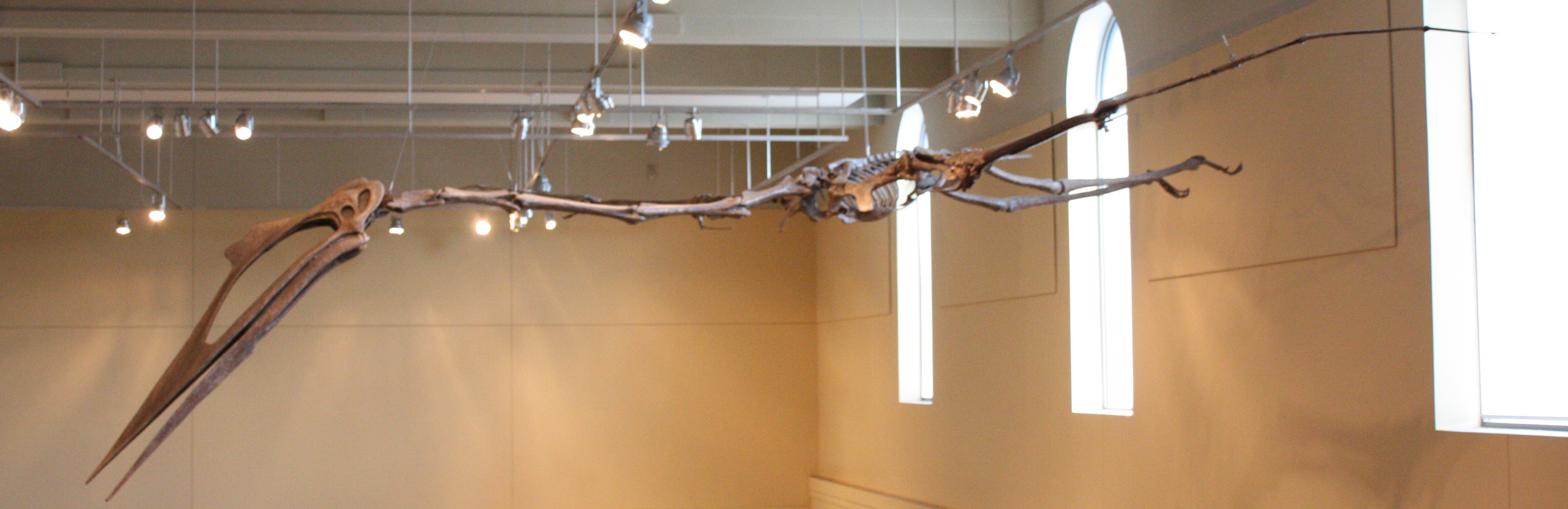
Make your own Quetzalcoatlus!


Back in my stint at the Carnegie, I had a great chat to Mark Klingler about his palaeoart. Mark mentioned that years ago he had created a little 'build your own pterosaur' kit where you could print out a Quetzalcoatlus he had designed and stick it together. He was extremely generous in offering this to the Musings to go up for people to do themselves, but he needed to check the copyright issues and find the necessary files.

Mark got back to me the other day to tell me that unbeknown to him, the files were already online and available on the Carnegie's own website. So problem solved, you can get them whenever you want and make your own (small) giant pterosaur. Just go here and follow the instructions. Mark was cunning enough to make it so that it's a skeletal view on one side and a life reconstruction on the other!

So get building and enjoy. my great thanks to mark for his original generous offer and for tracking down his files. Sure it's easy enough to get them where they are, but even he didn't know, so I'm delighted to bring this to a wider audience and well done to the Carnegie too for making this freely available for kids (and palaeontologists).

Monday, March 19, 2012

Does Air Density Make a Difference?


This is essentially a cross-post from H2VP (with some additions)

One thing I have been asked with some regularity is whether or not a somewhat denser Mesozoic atmosphere, particularly in the Cretaceous (compared to the modern one), could explain the giant size of Late Cretaceous pterosaurs or large dinosaurs.  In short, the answer is: probably not.

There is a reasonably good body of information regarding atmospheric composition during the Mesozoic.  During the Cretaceous, both oxygen and carbon dioxide levels rose slightly, and the total atmospheric density would have been slightly greater as a result - but the difference would have been relatively mild for large vertebrates.

Here is an example of a paper published on the effects of Cretaceous oxygen concentrations on plants: http://jxb.oxfordjournals.org/content/52/357/801.full, and there is a manuscript examining the effect of paleoatmosphere conditions on insects: http://jeb.biologists.org/content/201/8/1043.full.pdf.  There is a relatively recent paper on the Late Cretaceous atmosphere and its potential relationship to mass extinction as well: http://jxb.oxfordjournals.org/content/52/357/801.full

As you can see, plants and insects probably felt the effects of slightly higher oxygen and carbon dioxide concentrations, and indeed the insects of the Cretaceous included some relatively large species, as would be expected.  A slight increase in atmospheric density would have relatively little impact on the maximum size of dinosaurs or pterosaurs, however, and there is not actually any need for an extreme explanation for their size, anyway - despite being larger than living animals with similar lifestyles, none of the giant dinosaurs exceeded the expected maximum size for a walking animal, and no pterosaurs exceeded the limits for biological flight.  Quite a few pterosaurs exceeded the estimated limit for continuous flapping flight in a vertebrate animal (limit is roughly 25-30 kg, give or take), but that only means that they could not flap continuously over long distances and would have switched to soaring flight for long trips; it does not forbid them from flying.

There are three reasons why changes in atmospheric conditions have greater impacts on insects than vertebrate flyers.  First, the tracheal system that insects use for respiration is highly sensitive to oxygen partial pressure.  Second, since insects are typically small, they are often highly reliant on unsteady aerodynamics, which are much more sensitive to air density than steady dynamics.  Finally, insects are almost purely aerobic flyers, while many vertebrates can utilize some degree of anaerobic power (in large flying vertebrates, anaerobic power dominates).  Using anaerobic flight muscle provides a very large burst of power, without using oxygen, after which the muscle quickly fatigues.  Large vertebrates can therefore flap for short bursts, followed by periods of gliding, even when oxygen levels are low.  This option is typically unavailable to insects.

Thursday, March 15, 2012

Looking for the lost

Over on the Archosaur Musings I have a post up asking for help in finding all of the various 'missing' pterosaurs from the Solnhofen. In short, specimens which are out there but are not recorded in the literature. For simplicity, I've reproduced the whole post below, but if you know of any please post them over on the Musings as it's much easier for me to keep track of things there and already there are some reports coming in which is good to hear.

......................................

There have recently been a number of papers describing 'lost' or little known pterosaurs from around the world. I've covered the Rhamphorhynchus that sat undescribed in Dublin for over a century, and I've mentioned specimens on display in Japan that have never been in the literature. There are others too that are starting to come out, like a Pterodactylus in France and others in Hungary. While obviously some of these are making it into the literature, there are others that haven't (like those in Tokyo and I know of one in Kiel) and I'm most interested in finding them.

There's an obvious reason for this - completeness. While Peter Wellnhofer did a great job in the 70s of collating Solnhofen specimens and measurements in two major papers, a lot of time has passed since. New material has been discovered, and old material has come to light. I'm sure there's a significant number of specimens now out there available for study that are either not in the literature at all, or are only mentioned or illustrated and have no good descriptions or measurements put down.

These are of course well worth knowing about. Pterosaurs remain rare and history alone means that the Solnhofen is the best studied and best known set of pterosaur fossils going. Combined with the presence of both pterodactyloids and more basal forms, and generally large numbers of good quality material it is perhaps our premier source of data right now. As such knowing what we have and maximising this is important for science and can allow us to do bigger and better analyses, or sort through what we have and select specimens that can be sacrificed for sampling or are worthy of further attention and preparation.

In my experience many of these 'lost' specimens are often on display, right there and easy to see (as pterosaurs are rare and often a prime piece worthy of exhibition). Provided of course you are in the museum to see them! The Kiel specimen I mentioned was one such - to my knowledge or that of any of my colleagues I'd spoken too, they simply didn't have any Solnhofen material at all, none. So a pterosaur expert is rather unlikely to there to check out a tiny palaeontological collection which shouldn't contain anything of interest and let's face it, there's a lot of museums out there.

Bearing that in mind, if you do come across a Solnhofen pterosaur in an odd and usual place (i.e. not the Carengie, or London NHM or the like) do please let me know. Sure it might turn out to be a cast, or even a well-known specimen, but the number that are increasingly coming out of the woodwork make me suspect there's rather more out there and it would be great to try and track them all down and one day get them into the formal literature. If you have a photo or specimen number, even better, but a simple mention of what you saw in which museum would be a great start. I'm convinced there's a significant number of specimens out there and they are well worth finding.

Monday, March 12, 2012

Talk at the Royal Tyrrell Museum

Last week, I gave a pterosaur talk at the world famous Royal Tyrrell Museum, in Alberta, Canada.  The museum has its own YouTube Channel and has made my talk freely available here:

http://youtu.be/5wmds4zq5Eg

They also have a series of previous talks by other researchers recorded and available.

Cheers,

--MBH


Saturday, February 25, 2012

Staking the vampire pterosaur: Jeholopterus was NOT a vampire


It's a common misconception that staking the heart of a Stokerian vampire will do it in for good. In actuality, the characters of Bram Stoker's Dracula (above) only considered the undead truly out of action once they were staked through the heart (which only imobilised them, see, not killing them), decapitated, had their mouths stuffed with garlic flowers and the access to their tombs lined with holy masonry. This may seem like overkill, but, for the vampire mythos Stoker created, it is the only way to keep the blaggards down. In the last week, it's emerged that that palaeontological vampires need a similar heavy duty approach to ensure that they too don't continue to rise from the grave.

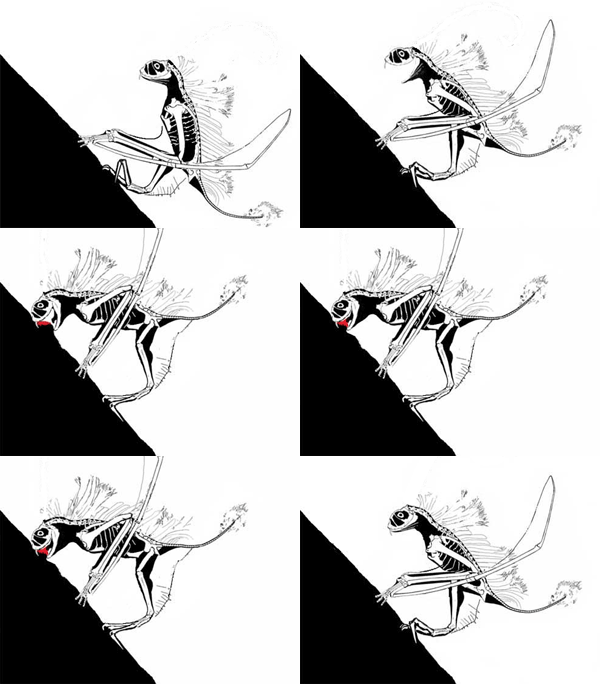
LinkEnter, stage left, the hypothesis that the anuroganthid Jeholopterus was a Mesozoic vampire bat equivalent (image, above, from my upcoming book, shows the anuroganthid Anurognathus with a more accurate Insect Hawking Cookie Monster of Doom appearance, not a vampire). Proposed by David Peters in an abstract for the SVP annual conference of 2003, cited evidence for this idea stems from large caniform teeth inferred on the Jeholopterus holotype using DP's infamous digital photo interpretation (for anyone unfamilar with DP's work, you can see the most recent incarnation of it here). It is well known that palaeontologists have almost never seen eye to eye with Peters' interpretations of fossils or methods of analysing them, and a small body of literature exists that directly refutes his work (e.g. Bennett 2005; Hone et al. 2009) . Many other papers also disagree with his methods or conclusions. DP acknowledges his 'heretical' views and, indeed, has even named his blog after them: The Pterosaur Heresies. Our very own Pterosaur.Net even gets a good kicking at various points at TPH, but that's OK: we have our opinions (which we consider to be well supported and credible), and Dave has his (which we consider to be very poorly supported). I think we have to live with the fact that we're not going to agree with everyone in science, and, frustrating though this can be at times, we're much better off making sure our own work is as watertight as possible than constantly bickering with others.

The vampire Jeholopterus made a brief splash back in 2003, but was widely condemned by the entire pterosaur community. To many, this simply proved - again - that SVP perhaps needed to pay closer attention to the work they were allowing into their conference, but that was that. No peer reviewed paper on the vampire hypothesis followed, and no independent confirmation that Jeholopterus or other anurognathids were sanguivorous has been proposed. Instead, the long-held view that anurognathids were ace aerial insect hawkers has prevailed (e.g. Bennett 2007; Habib 2011 [a follow up publication to which is in the works. I'm lucky enough to have been invited in on the authorship and can promise that some of the stuff in it should blow your little socks off]). The vampire pterosaur idea, it seemed, was dead, the only remnants being the abstract, a few media stories, and the Jeholopterus page at DP's website. This week, however, the vampire Jeholopterus meme has risen from the grave, being portrayed in a half-credible light in this article and picked up elsewhere online. Several people, including myself, were a bit miffed at this, and, in full on SIWOTI mode, left comments on these articles. The original article seems to be picking comments that agree with the tone of the article as their 'featured' comments, hiding perhaps more informed opinions in other pages of the article. Hence, seeing as most people won't easily find these remarks, I thought best to regurgitate mine here. In short, I want to provide a one-stop shop for clarity on the vampire pterosaur hypothesis:

  • The idea was not peer reviewed, and it's publication in a collection of conference abstracts is not of comparable standing to other hypotheses of anurognathid palaeoecology
  • There was never any 'debate' amongst pterosaur workers on this idea: it was never considered credible by qualified researchers in the first instance, and rejected outright from the start.
  • There is no evidence that Jeholopterus, or any other pterosaur, was a vampire
  • There is no 'David Peters vs. Goliath' story here. DP's work is considered with the same scrutiny, not more or less, than any other piece of science. His ideas are rejected by other palaeontologists (amateur and professional alike, the only difference between many of whom is that some are paid to study fossils) because they have not stood up to this scrutiny.
Any claims to the contrary suggest very lazy journalism, I'm afraid, so shame on those who have given this idea even a whiff of credibility. With that, I'll hand you over to my rambly self of yesterday, when I commented on the article that inspired this post. Said article may make for required reading before you continue.

--

This story has been told rather incorrectly. DP's 'publication' in 'the peer-reviewed Journal of Vertebrate Paleontology' was NOT peer reviewed: it was a short abstract for the SVP 2003 annual conference. I am confident as a 'professional' pterosaur worker myself that this paper would not have made it into any scientific journal, and it was rightly condemned by the pterosaur community as soon as it was made public. Along with the Bennett article mentioned here, a body of literature exists demonstrating that most, if not all, of David Peter's methods of reconstruction and image interpretation are flawed. The extraneous features he reconstructs for fossil animals (which have included, at one time or another, fantastic frills, sails, additional bones and teeth, long tails on short-tailed taxa, hatchlings clinging to their parent's body and others) have never been found on fossil specimens despite CT scanning, UV investigation and other analytical methods. The vast majority of DP's ideas are not corroborated by any studies except his own. In polite terms, DP's ideas are considered 'fringe' at best by palaeontologists, and very much the view of one individual. (animated vampire Jeholopterus feeding strategy, below)


I find it worrying that you wrote your article without uncovering or featuring these details. Likewise, the fact that you give the vampire Jeholopterus idea some credence with statements like 'what spurred the great debate' and 'without a living Jeholopterus to observe, we really cannot be sure of its unique attributes': there was never any debate, and the latter suggests a critical misunderstanding of scientific practise. Palaeontologists work, like all other sciences, by testing hypotheses: we are confident that Jeholopterus was not a vampire bat-like animal because it fails tests we can put against this idea. Does it bear large teeth for piercing flesh? No. None have ever been found on any actual specimen: the fact they have been found on someone's computer screen means nothing if they cannot be seen by some means on the actual fossil. DP probably picked up compression artefacts in the jpeg or cracks, shadows and prep marks in the matrix on the slab. Did Jeholopterus have a strong bite? Probably not, as the bones of the jaw are mechanically weak and slender, and ill-suited to anchoring strong muscles. Are there any alternative means it could use to pursue a vampire lifestyle? None that we can ascertain. Is there a more plausible hypothesis for the lifestyle of Jeholopterus? Yes: aerial insectivory, a lifestyle that decades of _actual_ peer-reviewed studies into anurognathid (the group that Jeholopterus belongs to) anatomy and biomechanics support without exception.

Finally, the portrayal of DP as a maverick, lone amateur 'informing' the body of professional palaeontologists is unfair. A great number of so-called 'amateur' palaeontologists produce work of the highest credibility without a whiff of controversy. Like DP, they work alone and draw their own conclusions, but find that their ideas are similar to those lucky enough to be paid to research palaeontological subjects. There is no conspiracy about preservation of dogmatic ideas or rejection of outsiders: the internet teems with blogs and forums where paid palaeontologists and 'amateuers' meet to discuss ideas at the highest level. I'm afraid to say I find this article very ill-informed and misleading, and hope this comment adds some balance to this page.

References

  • Bennett, S. C. 2005. Pterosaur science or pterosaur fantasy? Prehistoric Times, 70, 21-23.
  • Bennett, S. C. 2007. A second specimen of the pterosaur Anurognathus ammoni. Paläontologische Zeitschrift, 81, 376-398.
  • Habib, M. B. 2011. Functional morphology of anurognathid pterosaurs. Geological Society of America Abstracts with Programs, 43, 118.
  • Hone, D. W. E., Sullivan, C. and Bennett S. C. 2009. Interpreting the autopodia of tetrapods: interphalangeal lines hinge on too many assumptions. Historical Biology, 21, 67-77.
  • Peters, D. 2003. The Chinese vampire and other overlooked pterosaur ptreasures. Journal of Vertebrate Paleontology, 23(3), 87A.

Sunday, February 12, 2012

The top 5 most important pterosaur specimens

As usual when it's me on here, this is a repost from my blog. Still, if ever I wrote something that was made for Pterosaur.net this was it. So, here is something that does rather combine every aspect of pterosaur research into one neat package.


Just an idle bit of fun this, but the thought was running through my head and I thought there was a blog post in there somewhere so decided to have a go at it. All very subjective of course and hard to assess but there are issues of completeness, importance, the scientific information held or conveyed by the material and other things. Anywhere, here’s my effort at least (in no particular order):

1. The Dark Wing Rhamphorhynchus.

Specimens from the Solnhofen are not uniquely flat, but the vast majority are compressed into two dimensions. The sheer number of Rhamphorhynchus specimens means that we do have a great understanding of their anatomy and ontogeny, even if it is 2D and there are lots of specimens with bits of soft tissues or unusual details preserving. This specimen though pretty much has it all. It’s complete, the bones are nearly entirely in 3D and it comes with a magnificently preserved set of wing membranes – easily the best out there. Stick all that together and it’s a hell of a specimen.

2. Jeholopterus holotype

Sure Sordes is nice and already covered in pycnofibers, but Jeholopterus is much the better preserved with more details of both ptero-fuzz and the wings. As a bonus it’s by far the best preserved anuroganthid specimen (well in total, the juvenile Anuroganthus is magnificent but has no softs), an otherwise badly known but potentially very important group.

3. The Tokyo Anhanguera

Probably the single most complete and 3D specimen I know of. Sure there are a few bits missing, but unlike the dark-wing, every bone is free of the matrix and can be picked up, turned around, examined from every angle and checked. Sadly it’s a juvenile and so some of the features aren’t quite what they would be at adult, but it is one hell of a specimen for the actual gross skeletal anatomy.

4. The Darwinopterus + egg combo

This one is a bit fortuitious since it does rather let me get a two-for-one with both a transitional pterosaur (and just how significant that is for a number of reasons) and gives us a bona fide pterosaur egg. Each tells us so much about pterosaurs and pterosaur evolution, it’s an incredible animal.

5. The big Quetzalcoatlus.

Every specimen can tell you something, and there are surprises everywhere. The new Nyctosaurus and Thalassodromeus revealed how huge crests could get, the series of ‘Tapejara’s told us about the integration of soft tissues, Raeticodactylus served a warning about eudimorphodontid-like teeth for taxonomy. But head and shoulders over all of this is the giant specimen of Quetzalcoatlus (even if it isn’t yet properly described). Size is such a crucial aspect of the biology of any organism, but in this case it is simply so big and in a flying animal too, that it really was almost a gamechanger for our understanding of pterosaurs in their own right. That a flying animal could get this big was a shock (despite some of the wild estimates, 10 m is bloody massive!).

And to close out, a few near misses from the list: footprints that showed us how they walked, the Pterodactylus holotype which brought pterosaurs to the world, one of the embryos which proved they did lay eggs and gave us a window into their life history.